Showing posts with label 2014 Detroit Tigers. Show all posts

Friday, 7 November 2014

Stranding Inherited Runners 2014: Highlighting Tigers

Matt Snyder at CBS' Eye on Baseball (the Home for All Baseball Fans, as I think Dayn Perry puts it) has once again generated a list using Baseball Reference's Play Index of relievers performance in 2014 at stranding runners on base. Because the Tigers' relief corps has been a matter of some controversy this season, I thought I'd highlight their performance. These are drawn from a list of 110 relievers who over the season added up to having at least twenty-five runners on base when they came into the game.
Player        IRS%     Rank
Hardy         27.6      62
Alburquerque  27.7      63
Coke          36.5      92
Krol          42.1     103
The Tigers' relievers were not particularly good at keeping runners from scoring. None of them are in the top half of the ranking, let alone in an elite zone like the top third or quarter. This isn't really a surprise to those who followed the games. We can surmise from this that Brad Ausmus' main options in a jam during the season were Phil Coke and Al Alburquerque, although Blaine Hardy seems to have taken over from Coke after he arrived to stay.

It does raise the question of why Ausmus changed his bullpen set-up in the playoffs, though. Alburquerque had the second-best percentage by not very much. But, then again, the 2013 table shows he was a much riskier proposition the year before, with a IRS% of 35%.

Even more astonishingly, that 2013 performance was still good enough for second-best on the team. (Phil Coke's 33.3% was the best.) The Tigers may have come in for a lot of criticism for their bullpen this season, but last season was worse. Dombrowski's efforts to improve that sector show he achieved something.

Monday, 6 October 2014

Nationals: Do or Die, My Good-bye

I was an Expos fan. In 2004, I listened to many of the games during that last season by means of MLB's GameDay audio. Compared to the previous two seasons of the MLB Expos, that demanded a degree of fortitude and loyalty. I still bear a deep grudge towards Brian O'Nora, who during an interleague game called a foul ball fair for a home run. When the Expos were moved to Washington, I was upset and my initial response was to look for an alternative team to follow, settling on the Arizona Diamondbacks. However, as luck would have it, the Diamondbacks were playing in Washington at the start of the 2005 season, and I decided to listen to Charlie Slowes and Dave Shea. I was charmed by Slowes in particular, and gradually my familiarity with the 2005 Nationals' roster holdovers from the Expos, and their division-leading antics, had me sticking by the team.

For younger Nationals' fans, who found that where baseball teams are concerned it is better to receive than to give, the kind of humility required to hang on to fandom of a team that is moved is possibly hard to envisage. Longer-term Washington baseball fans might know the feeling well, especially after the original Nationals/Senators became the Twins and went on to a very successful 1960s while the Replacements really gave meaning to the old saying, 'First in war, &c'. In this case, I was rooting for a bunch of people who had made life very miserable with their taunts on message boards during 2002-4. Not many Expos' rooters followed me to Washington. In fact, many would despise me for sticking with the franchise.

The next four years saw me dividing my fandom between the Nationals and the team that I actually grew up with, the Detroit Tigers. The improbable 2006 World Series run by the Tigers did a lot to draw my interest, but my preference for National League baseball (no DH! — the reason I became a fan of a National League team in the first place) also pulled me back towards the ex-Expos. I was tugged in two directions.

In 2009, I made a conscious decision at the start of spring training to refocus on the Nationals, and I started writing this blog to help with that. The title of this blog is, in fact, a Latin pun on 'D.C.'. I paradoxically enjoyed following that losing 2009 team, despite its problems. But there were also annoyances, such as the horrible Rob Dibble & Bob Carpenter television duo, and the fact that Nationals Park clearly referenced not the Nationals' franchise history, but the history of Washington baseball. Now that's great for Washington baseball fans, but it creates problems outside of the District. And, in fact, there has been a constant tension between the Expos' heritage and the marketing problem of building a new fan-base. I've never really been comfortable with the Nationals borrowing the Twins' past, given that there was an Expos' past that the Nationals had every right to. But I also understood that the Expos' past could not speak with much authority to Washington's baseball fans.

2012, right down to Mr Slowes' outstanding home-run call on Jayson Werth's walk-off in Game #4 of the NLDS against the Cardinals, was for me a culmination. Despite being in Canada, not Washington, despite being nurtured into my baseball fandom in Tiger Stadium, not DC Stadium, my elation was just as great as that of anyone's along the Potomac. And the sadness that followed after the Game #5 loss was equally as great. I had followed the construction of that team from 2009 with interest. Those events hurt a bit more than the Tigers' loss to the Giants in the World Series. But when the 2013 season rolled around, something had changed between me and the Nationals. I still don't know what, but I felt a distance that wasn't there before. Was it the free agency of John Lannan? The acquisition of Denard Span? The trade of Michael Morse? Was it the fact that the bitter loss of the 2012 NLDS had cemented their identity as a Washington team, as opposed to a continuing example of the Expos' futile pursuit of post-season glory? Not even Slowes & Jageler could shift a sensation that something was rotten in the state of my Nationals'fandom. The 2014 season simply reinforced these feelings of distance. Instead I invested considerable emotion in the ups and downs of the Tigers, who literally uglied their way into an AL Central pennant.

Then, last Saturday night, there was the 1924 Flag That Will Fly Forever, marking the Washington team's World Series victory that season. Except that flag belongs to the Twins, who took it with them along with the makings of a competitive team when they left in 1960. Now I gather that something like it may have been flying over Nationals Park since it opened in 2008, but on Saturday the prominence given it in the television coverage rankled with me. First Washington baseball fans took someone else's team, and now they are taking another club's history. That's one way to look at it. One could just as easily argue that the Twins left it there when they moved to another city. But neutral arbiters have assigned it to the Twins. It's one of those areas where one's predisposition will determine what side of the argument one will find oneself on.

As the Tigers crashed out of the ALDS in miserable fashion, I came to a conclusion: the Expo in me has to let go of the Nationals. Unless I wind up living in the Chesapeake Bay area in the future, I will focus my baseball team fandom on the Tigers. Tonight will be the last game I watch as a fan of the Nationals. I will still make the post-season blog posts I intend to make about the 2014 Nationals, but they will be the last gestures towards a team that I have followed, in some fashion or another, since 2005. Whether the Nationals do or die, I say ave atque vale to a part of my life that sought to maintain ties to a dead franchise and a memory of past times.

Saturday, 30 August 2014

Kyle Ryan's AAA Outings

Kyle Ryan has spent all of the month pitching at the AAA level, and today he makes the jump to the big leagues. What can those minor-league outings tell us about what we could expect to see against the White Sox?

I like to use QMAX, a system developed in the days of the Big Bad baseball Annual, itself a lineal descendant of Bill James' old abstracts. QMAX is helpfully thought of as a means of distinguishing the varying quality of quality and non-quality starts. I have always found it especially useful in helping to understand minor-league outings, even though it was designed with Major-League statistics. It looks at two components of pitching, the ability to miss bats (stuff) and the ability to pitch in the zone (command). Outings are categorised by where they fall on a matrix, such as 'the Success Square', 'the Hit Hard region' and some don't fit into any category at all. The 'Power Precipice' is a zone where pitchers who successfully overpower hitters still find themselves teetering on the brink of a fall because they walk too many. For young players, that's a hopeful sign, because improved command will supplement good stuff. By contrast, the Elite Square reflects the stingiest of pitchers in allowing chances for the opposition, and suggest a pitcher who is ready to try the next level. Here's a list of Kyle Ryan's performances at the AAA level.

2 August Elite Square
 8 August Elite Square
14 August Uncategorised
20 August Elite Square
25 August Success Square/Power Precipice

Now what we know about minor-league baseball is that for pitchers, a lack of command at AAA will mean problems walking batters in the big leagues. We also know that AAA fielders aren't quite as good as major-league ones, so pitchers will suffer a few more hits than they might. In terms of hits given up, the Toledo Mud Hens look to be around league average.

The AAA outings suggest that Ryan is ready to have a cup of coffee at the major-league level, as he has shown some ability at mastering AAA hitters. He is very good at keeping the ball in the strike zone, although it may be his success depends on being a little too crafty for major-league hitters (which is to say that they are harder to fool than minor-leaguers). His k/9s indicate he is a pitch-to-contact type, and his numbers at Erie (AA) might give a clearer idea of what we might expect in the hitter's park that the White Sox play in. There he gave up almost twice as many hits as he did at Toledo, and had an HR/9 of 1.1.
I suspect we'll see something on the order of 5 IP, 5 R, 6 H, 1 HR, 2 BB and 2 K. I'd settle for that.

Wednesday, 27 August 2014

Tigers 2014 Game 130: V-Mart vs McCarthy

Victor Martinez' duel with Brandon McCarthy last night showed exactly why baseball is a game of fine distinctions, and well worth one's close attention. Let me show you three strike-zone plots from BrooksBaseball.net.

1st inning

3rd inning

6th inning

V-Mart, as I like to call him, went 1 for 3, which is a .333 batting average, so he did rather well by traditional standards. More than that, though, we can see that in the first plate appearance McCarthy kept changing the plane on V-Mart, until V-Mart chased a pitch well off the plate that he foul-tipped into the catcher's glove. Tom Gage, of the Detroit News, tweeted that it was 'a heckuva pitch', which put me on alert.

In the third, V-Mart swung at the first pitch, a sinker to a spot that McCarthy hadn't used in the first PA, and sent a grounder to Mark Teixeira at first. Teixeira made the play unassisted.

In the sixth, the two previous PAs came together. McCarthy went back to working highish, outside and away. When that didn't work, he went back to the sinker, only this time he reversed the first PA, now working down and over the plate. V-Mart connected for a single on this one, and eventually would score on Nick Castellanos' single.

The only slight cloud on the evening was the nine hits that Rick Porcello surrendered. He made up for that with not issuing a single walk, but his performance was not dominant, and explains why I never felt comfortable given the Tigers' bullpen uncertainties. This was a good win for the Tigers, despite Alex Gordon's walk-off in Kansas City, which meant the Tigers could only keep pace with the Royals. I'm afraid I'm not entirely sold on #RoyalsDevilMagic yet, no matter how frequently Rany Jazayerli tweets about it. I'm still going with Jim Price's view that 'the MoJo is moving towards Detroit'.

Monday, 25 August 2014

Tigers' 2014 Game 128: Miguel Cabrera's Double Plays

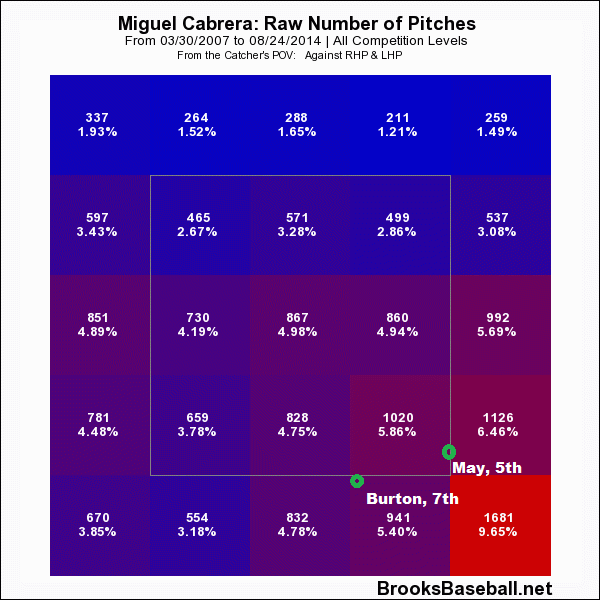
Miguel Cabrera hit into two double plays on Saturday night, the first of which killed off a rally, and the second of which possibly cost the Tigers an additional insurance run. In this case it appears that Cabrera made the right choice but got a bad result. Those pitches were in the general area where he has enjoyed the best success. Offered in evidence, a heat map taken from BrooksBaseball.net On this I have done my own 'eyeball Mark One' plot of where the balls would have been. I also include the two plots, again taken from BrooksBaseball.net, of the two plate appearances using PitchFX to show the balls relationship to the strike zone so you can decide if my locations are about right.

Saturday, 23 August 2014

Summer of Discontent

Yesterday's ugly game between the Tigers and the Twins is, one hopes, that moment when the Tigers hit rock bottom. I'm thankful that it is the Royals who have chased down the Tigers this season, because they are the only AL Central team that I don't feel some Tigers-inspired animosity towards.

When one looks at the season overall, the Tigers have not been what we would be led to believe they were since the All-Star break. The last time they put together a winning streak of more than three games was one of five games 8-12 July (which included beating the Royals a couple of times). Since the All-Star game, the Tigers have only the one three-game winning streak, the beating up of the poor Colorado Rockies at home in the beginning of August. By contrast, the Tigers have suffered three four-game losing streaks in that time, if one includes the pre-break loss on 13 July against the Royals.

After last night, it is easy to blame the bullpen for the woes, but I don't see it like that. In 34 games starting 18 July, the Tigers have scored four or fewer runs 22 times. That is two-thirds of their games. Their record in those games is 5-17. They scored 119 runs and allowed 251, for a Pythagorean winning percentage of .207 against an actual one of .227. By contrast, in the 91 games before the break, the Tigers scored four or fewer runs 50 times, or just over half of their games. Their record in those games was 16-34. They scored 171 runs in those games, and allowed 300. That's an actual .320 winning percentage against a Pythagorean .265 winning percentage.

The Tigers are still beating their Pythagorean winning percentage in these low-scoring games. The big problem is a greater proportion of their games fall into this category, which is a fault of the hitting, not the pitching. (Don't forget, this excludes yesterday's game, because the Tigers scored six.

This picture, created using Bill Petti's spray chart tool sums up a serious problem for the Tigers, one that I think needs to be addressed in constructing the lineup. It compares Miguel Cabrera's batted-ball hits and outs for 2014 (right) versus 2013 (left). Note how this season the batted balls don't seem to fly as far, and how many fall just short of the seats. This power outage is killing the Tigers. The Big Man needs to adjust his approach, and maybe needs to be protection for Victor Martinez. Something must be done, because time is running out.

Tuesday, 12 August 2014

Robbie Ray's Minor League Outings

So Robbie Ray has rejoined the Big Club, and is set to pitch against the Pittsburgh Pirates tonight. We last saw him in May, when he followed two good outings against the Red Sox and the Twins with a bit of a confidence-wrecker versus the Rangers. How has he been doing since?

I like to use QMAX, a system developed in the days of the Big Bad baseball Annual, itself a lineal descendant of Bill James' old abstracts. QMAX is helpfully thought of as a means of distinguishing the varying quality of quality and non-quality starts. I have always found it especially useful in helping to understand minor-league outings, even though it was designed with Major-League statistics. It looks at two components of pitching, the ability to miss bats (stuff) and the ability to pitch in the zone (command). Outings are categorised by where they fall on a matrix, such as 'the Success Square', 'the Hit Hard region' and some don't fit into any category at all. The 'Power Precipice' is a zone where pitchers who successfully overpower hitters still find themselves teetering on the brink of a fall because they walk too many. For young players, that's a hopeful sign, because improved command will supplement good stuff. Here's a list of Robbie Ray's performances

27 May   Uncategorised
1 June   Hit Hard
12 June  Uncategorised
17 June  Uncategorised
22 June  Success Square/Power Precipice
27 June  Success Square
2 July   Uncategorised
7 July   Uncategorised
13 July  Hit Hard
20 July  Success Square
25 July  success Square
30 July  Hit Hard
4 August Success Square/Power precipice

Now what we know about minor-league baseball is that for pitchers, a lack of command at AAA will mean problems walking batters in the big leagues. We also know that AAA fielders aren't quite as good as major-league ones, so pitchers will suffer a few more hits than they might. In terms of hits given up, the Toledo Mud Hens look to be around league average.

The minor-league outings suggest that Ray is going to have some problems at the big-league level this time round. His command is wayward and he gives up too many hits to say he can get by on his stuff. His K/9 is really down this season, compared to when he was a National. In his uncategorised starts he is almost always let down by his walks. On the bright side, and something not measured in QMAX, is that he keeps the ball in the park. His HR/9 is 0.6 in AAA. If he can get a few "at 'em" balls, and continue to keep the ball in the park, he might serve as a useful stopgap for the Tigers in the present crisis. Tigers' fans need to keep an eye out for ground balls, and the Tigers turning the double play behind him. If that doesn't happen, the slack will have to be picked up by the hitters and the bullpen, and that hasn't been working out too well lately.

Friday, 1 August 2014

EarlyThoughts on Deadline Deals

The trade deadline day proved suitably dramatic. Here is a roundup of my thoughts on the deals involving the teams I keep an eye on.

David Price for Drew Smyly, Austin Jackson and Will Adames I don't think one can analyse this deal properly without taking into account the deal in the offseason that sent Doug Fister to the Washington Nationals, the decline of Justin Verlander and contract negotiations with Max Scherzer. Smyly didn't quite step into Fister's shoes, while the other two elements have put the Tigers in a position of not having more than one plausible candidate for #1 Ace status for 2015, after several years of having two. Trading for Price is a signal to Scherzer that the Tigers are re-tooling for a Scherzer-less future, and puts pressure on Scherzer to think carefully about whether his chances for post-season play may be as good for more dollars elsewhere. But, my goodness, it will take deep pockets to sign both Price and Scherzer.

Having said that, my own impression is that Price may be, as I suggested about Joakim Soria, a player whom the Tigers are getting possibly as he has passed his best. He did not start the season well, although he has come on strong subsequently. Furthermore, I don't like the effect that trading Jackson will have on the Tigers' outfield defence. Verlander, who already has problems, and the newly acquired Price may in particular suffer (although possibly not as much as Scherzer, which further adds to my view that some of this trade is about Scherzer). While Adames was showing promise, the presence of Jose Iglesias and Eugenio Salazar in the organisation meant the Tigers had the depth to deal away a good prospect. Overall, though, I think this trade did not particularly strengthen the team for 2014, but has made it worse in the medium term, if only a little bit. (But a lot if the Tigers cannot sign either of Price or Scherzer.)

Asdrubal Cabrera for Zach Walters This deal is about... well, it is really about hitting. The Nationals have had great difficulty driving in runs for most of the season, and Cabrera ought to make that aspect of their game better. But the deal is really about injuries. I don't think there would be a problem with Anthony Rendon at second base and Ryan Zimmerman at third base and Danny Espinosa on the bench, but the Z-Man can't stay in the field, and the Nationals are really not as good a team without him. I'm not at all convinced that a mid-season shift is going to be as painless for the Nationals' infield defence as some people think. I see the potential for major improvement for 2014 here, at no major cost to the medium-term outlook.

The Marlins' Six-Player Swap with the Astros This is the most appealing trade of the day for me. Jarred Cosart gives the Marlins some depth to the rotation, an area they have been lacking in this season. Enrique Hernandez and Andrew Wates are interesting prospects, and I do wonder if Hernandez is going to move to second base, a la Cabrera with the Nationals. I view both Jake Marisnick and Colin Moran as prospects with busty tendencies. Francis Martes is too far away right now for a team that has an outside chance at something in the immediate future not too gamble on giving away for pieces that might strengthen that chance. I see upgrades for the Marlins all round, here.

Thursday, 24 July 2014

Joakim Soria a Tiger?

I just saw a tweet from @RobertMurrayMLB about a rumour that Joakim Soria was to become a Tiger. Let's do a quick-n-dirty comparison of what he might offer the Tigers in one particular area. The comparison is with closer Joe Nathan.

Four Seamer, Soria 140%, Nathan 40%
Slider Soria 161%, Nathan 56%
Curve Soria 112%, Nathan 32%
change Soria 89%, Nathan 0%
Sinker Nathan 48%

BrooksBaseball.net can show you how many times a pitch is 'whiffed' (swung on and missed), which becomes the whiff percentage. A league-average rate for a four-seam fastball is 16% whiffed. Soria's four-seamer is 40 per cent better than that, while batters only whiff on 6 or so of every hundred of Nathan's four-seamers. Soria's four-seamer, slider and curve are all better than league average, while all of Nathan's offerings are worse than average. Soria has the potential to improve greatly the Tigers' closer capability.

Now, having said that, a warning — Soria's performance has declined sharply this month, compared to the rest of the season. Tigers fans should hope that he reverts to his performances earlier in the season.

Friday, 18 July 2014

2014 Tigers' HItters' Batted Balls in Review #1

This review uses a method involving batted balls to examine whether hitters might be regarded as 'unlucky'. Another way to think about it is to see who might be hitting over their heads, or who might be suffering from an excess of 'at 'em' balls and may be likely to improve.

As anyone familiar with sabermetrics knows, one can evaluate batting events by means of linear weights. What this means is that a single is worth about two-fifths of a run while a home run, because it can drive in the men on base, is worth over three times a single. Research has revealed that types of batted balls can assign similar values. Line drives are worth a lot, while infield flies are almost as good as strike outs. There is a problem in deciding what category to place a batted ball sometimes, especially the difference between a fly ball and a liner, as symbolised by the neologism 'fliner'. So one needs to treat these numbers with a degree of circumspection.

What this chart shows is the difference between a batted-ball linear weight and Fangraphs' wRC. wRC gives a supposed aggregate number of runs that should have been scored based on hitting events. Some people have flares falling in, while others hit the ball hard, but see it caught. The batted ball number also includes Ultimate Base Running, to make it more compatible with wRC. Note that the chart excludes pitchers' hitting. The first column is wRC, the second the batted ball expected runs.

wRC    BBXR
J. D. Martinez       43     18    +25
Victor  Martinez      64     58    + 6
Alex  Avila           32     26    + 6
Miguel  Cabrera       63     58    + 5
Rajai  Davis          36     36      0
Eugenio Salazar      15     15      0
Bryan  Holaday         8      9    - 1
Tyler  Collins         0      1    - 1
Alex  Gonzalez         1      4    - 3
Danny  Worth           1      5    - 4
Torii  Hunter         37     42    - 5
Ian  Kinsler          57     64    - 7
Don  Kelly            10     17    - 7 
Andrew  Romine         9     16    - 7
Nick  Castellanos     35     45    -10
Austin  Jackson       37     50    -13
JD-Mart has been massively fortunate on the outcomes of his batted balls, making up for the bad luck of Castellanos and A-Jax. The optimist will say all this will even out in the end. The pessimist, however, would say that the more extreme result is more likely to regress to the mean, possibly creating a run-production problem during the second half of the season. They could be the keys to the hitting during the second-half.

Wednesday, 16 July 2014

2014 Tigers' Fielding Review #3

Here is an update to my regular survey of the Tigers' fielding. My source for this is Fangraphs, which includes all the main metrics that interest me except for Michael Humphreys' Defensive Regression Analysis.* From Fangraphs, I've used Mitchel Lichtman's Ultimate Zone Rating, my personal first choice of the 'converted-to-runs-play-by-play' metrics, and my preferred measure of RZR. The last is Revised Zone Rating, which is like a fielding average but counts balls hit into a zone, rather than those the fielder actually reached. I have included the league positional averages for RZR, to help give the players' numbers some context. DRA is added to these two, while I have dropped Dewan's Defensive Runs Saved. Note that catchers do not have a Zone Rating. Instead, I have used the runs saved by framing, supplied by StatCorner.com

Player              UZR    Change    RZR   Change    ALAverage     DRA    Change   PFr
Avila   (C)         n/a      --      n/a     ---         n/a      - 3.5   -2.2     -8.1
Holaday (C)         n/a      --      n/a     ---         n/a      - 1.1    0       -4.2
Kinsler (2B)        5.2     -1.2    .826   +.004        .799      - 7.4   -4.3      n/a
Jackson (CF)       -4.6     -0.7    .920   +.004        .909      - 2.2   +1.9      n/a
Cabrera (1B)        6.3     +0.1    .825   +.013        .800       18.1   +4.3      n/a
JD Martinez (LF)   -2.4     +0.3    .875   +.014        .881      - 3.2   +0.9      n/a
Rajai  (LF)        -3.6     +3.3    .856   +.008        .881      - 0.1   -2.2      n/a
Romine (SS)        -2.1     +0.6    .722   +.011        .752      - 4.2   +1.0      n/a
Hunter (RF)       -12.0     +1.9    .863   +.022        .888      - 9.0   +2.0      n/a
Castellanos (3B)   -9.1     -2.7    .616   +.005        .705      - 2.7   +2.1      n/a
Suarez (SS)         0.3     +0.1    .808   +.119        .752        2.8   +1.8      n/a
minimum 170 innings

RZR continues its positive views on the Tigers' fielding, seeing improvement across the board. Corner outfield and third base still are below the league average, but everywhere else the Tigers are getting to more balls in the zone than the average player at the position.

UZR sees an overall improvement, up by 1.7 runs. The extreme results see Rajai Davis playing better, while Nick Castellanos plays worse. DRA sees even more improvement, with the team overall up by 5.3 runs, or half a win. However, we ought to bear in mind that the last review showed a sharp fall in Tigers' fielding, and they have only made up part of that ground. A good part of the gains come from an improved showing by Torii Hunter, who is up by sizeable amounts across the board. I can't help but look at DRA and think that some kind of accounting trick has transferred some of Ian Kinsler's fielding to Miguel Cabrera. We might want to keep an eye on that.

The sharpest divergence comes at left field and third base, with Rajai Davis' UZR way up, while his DRA rating is down. Castellanos and, to a lesser extent, Austin Jackson reverse that.

On pitch framing, Alex Avila's previous improvement was largely undone, losing -1.1 runs. Brian Holaday also fell by 0.8.
____
* These are available at the Baseball Gauge of Seamheads.com. Humphreys wrote the excellent Wizardry, which is a way of looking at fielding using only the traditional statistics, and not the newfangled play-by-play metrics.

Sunday, 13 July 2014

Tigers 2014 Games 76, 77, 78: non satis cursus

The Tigers deserved to lose the Sunday game, as Drew Smyly had terrible outing, but the previous games featured pitching performances that, while not dominant, were theoretically good enough to win when given average run support. Now, in the 2014 American League, that means four or five runs. Rather logically enough, the Tigers split the games. In Max Scherzer's start, the Tigers, just, scored four and won. For Justin Verlander, however, the Tigers could only score three, and lost. What's more is that there were few chances for the Tigers to add a run or two more. Their bats were shut down pretty completely by throughout the game by the Astros' Brad Peacock. The best chance came in the third inning, when both Torii Hunter and Miguel Cabrera failed with runners on first and second. Both are among the worst performers with the bat as far as LI Win Values tell us. All of this is a roundabout way of saying that the defeat was not entirely Blaine Hardy's fault.
QMAX ratings:   (4,3) for Verlander (Success Square)
                (4,2) for scherzer (Succcess Square)
                (7,5) for Smyly (Hit Hard)

Bullpen Awards: Goat's Head for Hardy

Batters' Aggregate LI Win Values: 
Suarez        0.637
Kinsler       0.506
Castellanos   0.276
Holaday       0.102
Romine        0.080
Avila        -0.004
JD Mart      -0.031
V-Mart       -0.259
Cabrera      -0.340
Jackson      -0.419
Hunter       -0.447
Rajai        -0.685

Thursday, 3 July 2014

2014 Tigers' Fielding Review #2

Here, a couple of days late, is an update to my regular survey of the Tigers' fielding. My source for this is Fangraphs, which includes all the main metrics that interest me except for Michael Humphreys' Defensive Regression Analysis.* From Fangraphs, I've used Mitchel Lichtman's Ultimate Zone Rating, my personal first choice of the 'converted-to-runs-play-by-play' metrics, and my preferred measure of RZR. The last is Revised Zone Rating, which is like a fielding average but counts balls hit into a zone, rather than those the fielder actually reached. I have included the league positional averages for RZR, to help give the players' numbers some context. DRA is added to these two, while I have dropped Dewan's Defensive Runs Saved. Note that catchers do not have a Zone Rating. Instead, I have used the runs saved by framing, supplied by StatCorner.com

Player              UZR    Change    RZR   Change    ALAverage     DRA    Change   PFr
Avila   (C)         n/a      --      n/a     ---         n/a      - 1.3   -2.3     -7.0
Holaday (C)         n/a      --      n/a     ---         n/a      - 1.1   -1.5     -3.4
Kinsler (2B)        6.4     +2.2    .822   +.014        .799      - 3.1   -1.9      n/a
Jackson (CF)       -3.9     -4.7    .916   -.001        .909      - 4.1   -1.9      n/a
Cabrera (1B)        6.3     +2.5    .812   -.011        .800       13.8   +4.5      n/a
JD Martinez (LF)   -2.4     -0.8    .861   -.039        .881      - 4.1   -4.5      n/a
Davis  (LF)        -6.9     +0.6    .848   +.010        .881        2.1   +1.8      n/a
Romine (SS)        -2.7     -0.2    .711   +.002        .752      - 5.2   -0.8      n/a
Hunter (RF)       -13.9     +0.1    .841   +.016        .888      -11.0   -1.6      n/a
Castellanos (3B)   -6.4     -5.2    .611   -.004        .705      - 4.8   -1.4      n/a
Suarez (SS)         0.2      --     .769     ---        .752        1.0     --      n/a
minimum 160 innings

During the past two weeks, the metrics that convert fielding data to runs show the Tigers' fielding has mostly deteriorated quite sharply. UZR sees the Tigers' numbers decline by 5.5, or half a win. DRA paints an even worse picture, with a decline of 9.6 runs, or almost an entire win. The same broad outlines discussed last time still persist. The Tigers' outfielders are not very good defenders, UZR evaluating them at -27.1 and DRA at -17.1. The left side of the infield is also a point of weakness (UZR -8.9, DRA -9), while the right side is the Tigers' greatest strength in the field (UZR +8.5, DRA +10.7). Mostly the systems agree with each other with the exception of Ian Kinsler, whom UZR sees as a positive fielder, but DRA thinks is a negative one. The opposite applies to Rajai Davis.

However, RZR paints a more positive picture. Kinsler, Austin Jackson and Miguel Cabrera have been all above-average fielders at their position. The systems divide over Jackson, who is an asset under RZR, and a negative factor under the other two. Looking at the UZR for all AL centrefielders, it seems that while UZR thinks Jackson has good range, his arm is below-average and he makes too many errors.

A brief word about Eugenio Suarez: so far all the systems see him as above average. Suarez Runs Created are also higher than other shortstops the Tigers have tried out as regulars. Perhaps a lot of the credit for the Tigers' recovery from a late-spring swoon is down to him.

On pitch framing, Alex Avila has improved, but Bryan Holaday has got a lot worse.
____
* These are available at the Baseball Gauge of Seamheads.com. Humphreys wrote the excellent Wizardry, which is a way of looking at fielding using only the traditional statistics, and not the newfangled play-by-play metrics.

Sunday, 29 June 2014

Tigers 2014 Games 73, 74, 75: verrunt in Texas

The Tigers began their Texas tour with a visit to the Ballpark at Arlington, possibly my least favourite ballpark in the major leagues, with its pastiche approach to architectural design. They came away with three victories, led by the bats of Ian Kinsler and Victor Martinez. The starting pitching was solid, with an excellent start from Rick Porcello, but the bullpen again suffered ugly moments, with both Joe Nathan and Al Alburquerque giving cause for concern in Game 74 (25th June). From here it was on to Houston, to face an Astros team that wasn't playing with quite the verve it had in late May and early June.

QMAX ratings:   (3,3) for Smyly (Success Square)
                (5,3) for Sanchez (Uncategorised)
                (1,2) for Porcello (Elite Square)

Bullpen Awards: None

Batters' Aggregate LI Win Values: 
Kinsler       0.285
V-Mart        0.230
Avila         0.066
Suarez        0.061
Davis         0.054
Jackson       0.029
JD-Mart       0.005
Cabrera       0.004
Holaday      -0.018
Castellanos  -0.049
Hunter       -0.111

Tuesday, 17 June 2014

2014 Tigers Fielding Review #1

I am adding the Tigers to my survey of fielding numbers, which I have been meaning to do since the start of providing these. So I will alternate the Tigers and the Nationals, with updates every other week. My source for this is Fangraphs, which includes all the main metrics that interest me except for Michael Humphreys' Defensive Regression Analysis.* From Fangraphs, I've used Mitchel Lichtman's Ultimate Zone Rating, my personal first choice of the 'converted-to-runs-play-by-play' metrics, and my preferred measure of RZR. The last is Revised Zone Rating, which is like a fielding average but counts balls hit into a zone, rather than those the fielder actually reached. I have included the MLB positional averages for RZR, to help give the players' numbers some context. DRA is added to these two, while I have dropped Dewan's Defensive Runs Saved. Note that catchers do not have a Zone Rating. Instead, I have used the runs saved by framing, supplied by StatCorner.com

Player              UZR    Change    RZR   Change    MLBaverage     DRA    Change   PFr
Avila   (C)         n/a      --      n/a     ---         n/a        1.0     --     -8.8
Holaday (C)         n/a      --      n/a     ---         n/a        0.4     --     -2.0
Kinsler (2B)        5.2      --     .822     ---        .789      - 1.2     --      n/a
Jackson (CF)       -3.9      --     .917     ---        .924      - 2.2     --      n/a
Cabrera (1B)        3.8      --     .823     ---        .812        9.3     --      n/a
JD Martinez (LF)   -1.6      --     .900     ---        .872        0.4     --      n/a
Davis  (LF)        -4.5      --     .838     ---        .872        0.3     --      n/a
Romine (SS)        -2.7      --     .709     ---        .775      - 4.4     --      n/a
Hunter (RF)       -14.0      --     .825     ---        .895      - 9.4     --      n/a
Castellanos (3B)   -1.2      --     .615     ---        .709      - 3.4     --      n/a
minimum 130 innings

Without the same amount of information monitored as this blog has for the Nationals, it is impossible to ascertain whether the Tigers' fall-off in performance is associated with bad fielding. However, there are several obvious pieces of information to draw from these numbers. One is that the Tigers' outfielders aren't doing very well. On all measures we see negative numbers except for J.D. Martinez' RZR and DRA, and Rajai Davis' DRA. But the DRA numbers aren't much above average.

The infield pffers a slightly better picture, with Ian Kinsler and Miguel Cabrera doing well under UZR and DRA is really enthusiastic about Cabrera. However, RZR sees the left side of the infield as quite a problem, with both Andrew Romine and Nick Castellanos well under the league average.

I do have data for overall team fielding going back some weeks. The Tigers' team UZR has fallen quite sharply over the last ten days to two weeks, from average-ish to moderately bad. (UZR thinks the worse teams are the Indians and Astros). The Tigers are probably at the fringe of what is tolerable. Defensive Runs Saved sees the picture a bit worse, with the Tigers being the fourth-worst team in MLB. RZR shares UZR's ranking.

On pitch framing, Alex Avila is one of the worst in baseball, with only three catchers with lower scores.
____
* These are available at the Baseball Gauge of Seamheads.com. Humphreys wrote the excellent Wizardry, which is a way of looking at fielding using only the traditional statistics, and not the newfangled play-by-play metrics.

Friday, 30 May 2014

Nationals 2014 Game 52 and Tigers 2014 Game 49: illi contigit et tunc mea felis moriut

The Nationals went 0 for 8 with runners in scoring position, and Anthony Rendon managed to be at the plate for three of those. More and more I think I want to see him switch with Span and move into to the leadoff position. He walks a bit more than Denard Span, and maybe he'll do a better job of setting the table than coming up with men on. (Not that it makes a lot of difference after the first time through the lineup.) The problem, though, is that Span hits a lot more ground balls than Rendon, and certainly the tenth would have ended more quickly if they had been swapped yesterday, as it seems like Span would have grounded into a double play.

Despite my worries about Jordan Zimmermann, yesterday he put in a fringy quality start, at the limit of the QMAX Success Square despite giving up eight hits. He threw more fastballs, more breaking balls and fewer sliders. His fastballs look like they had a bit more velocity, but at some cost in movement.

Highest Leverage PA:     6.1, McGehee single vs Barrett, Marlins 10th. 
Highest LI Win Value:   -.773 McGehee single vs Barrett, Marlins 10th.
QMAX rating:             (4,3) for Zimmermann (SS).
Bullpen Award:           Barrett, Goat's Head.
Batters' Aggregate LI Win Values:
Span           0.876
McLouth        0.837
Desmond        0.163
Hairston       0.097
Espinosa       0.069
Ramos         -0.010
Zimmermann    -0.022
Moore         -0.032
Dobbs         -0.289
Frandsen      -0.466
LaRoche       -0.496
Werth         -0.511
Rendon        -0.810

vs Mets

vs Marlins


Having met disappointment in DC, I headed across country via the magic of the Internet and was entranced by a eminently watchable pitching duel between Anibal Sanchez and Scott Kazmir in Oakland. Kazmir's amazing 'fall off the table' pitch time and again fooled Tiger batters. Sanchez met him pitch for pitch, working the zone in such a way that gained the umpire's approval but left the Athletics to stalk away shaking their heads with grimaces of disgust. Sanchez was pulled in the ninth after giving up a double and then the ghost of Jose Valverde, disguised as Joe Nathan, took the mound. 'Oimoi', as they used to say in Ancient Greek tragedy.

Highest Leverage PA:     7.5, Donaldson HR vs Nathan, Athletics 9th. 
Highest LI Win Value:   -1.819, Donaldson HR vs Nathan, Athletics 9th.
QMAX rating:             (1,1) for Sanchez (ES).
Bullpen Award:           Nathan, Goat's Head.
Batters' Aggregate LI Win Values:
Rajai          0.026
V-Mart         0.004
A-Jax         -0.014
Worth         -0.020
JD-Mart       -0.039
Cabrera       -0.038
Castellanos   -0.044
Hunter        -0.047
Avila         -0.085
Kinsler       -0.188

Tigers 2014 Game 48: Currens Hominis

This win belonged to Rajai Davis, with that alert steal of third that almost resembled a high-school level game, but I think was down to Abad's focus on getting the batter out. Al Alburquerque gains a Hero's Palm even though, in terms of Win Expectancy, both Joba Chamberlain's eighth and Joe Nathan's ninth innings had more value. Alburquerque faced the heart of the Athletics' batting order in earning his palm. The last out of Alburquerque's stint, a one-handed catch by J D Martinez, was scary. He only just made it.
27 May 2014
Highest Leverage PA:     4.3, PA#67, A-Jax 6-4 force vs Gregerson, Tigers 8th. 
Highest LI Win Value:   -.353 PA#39, Jaso HR vs Scherzer, Athletics 4th.
QMAX rating:             (6,3) for Scherzer (Hit Hard).
Bullpen Award:           Alburquerque, Hero's Palm.
Batters' Aggregate LI Win Values:
JD-Mart        0.363
Cabrera        0.171
Castellanos    0.087
Avila          0.083
Rajai          0.076
Hunter         0.056
V-Mart        -0.028
Kinsler       -0.072
Romine        -0.092
A-Jax         -0.093
Kelly         -0.209

Tuesday, 27 May 2014

Tigers 2014 Game 47: Decem multis etiam est

Think back to Game 35 of the Nationals' season, three weeks ago on 9th May. Tommy Milone was backed up by three home runs, while Scott Hairston managed the highest LI Win Value with .022. This was almost the same, except that the Athletics hit FIVE home runs off Tigers' pitching, including the 8th inning grand slam off Phil Coke that seemed almost needless.

Highest Leverage PA:     1.7, PA#7, Cespedes pop-out vs Smyly, Athletics' 1st.
                         1.7, PA#8, Lowrie's fly-out vs Smyly, Athletics' 1st. 
Highest LI Win Value:   -.111, PA#13, Moss HR vs Smyly, Athletics' 2nd.
QMAX rating:             (6,4) for Smyly (Hit Hard).
Bullpen Award:           None.
Batters' Aggregate LI Win Values:
Romine         0.041
Cabrera        0.025
Castellanos    0.023
Worth         -0.036
V-Mart        -0.044
Holaday       -0.055
A-Jax         -0.056
Rajai         -0.062
Hunter        -0.063

Friday, 23 May 2014

Tigers 2014 Game 37: Perfectio

Highest Leverage PA:     4, PA#54, Pierzynski GDP vs Krol, Red Sox' 8th.
Greatest LI Win Value:   .276, PA#54, Pierzynski GDP vs Krol, Red Sox' 8th.
QMAX rating:             (2,4) for Scherzer (Success Square).
Bullpen Award:           Ian Krol, Hero's Palm.
Batters' Aggregate LI Win Values:
Hunter         0.069
Cabrera        0.010
Rajai         -0.026
A-Jax         -0.038
Castellanos   -0.040
Kinsler       -0.063
Worth         -0.073
Avila         -0.116
V-Mart        -0.148
The ideal baseball game, to me, has always been the one-run game, in which there are many baserunners, but only one scores. This game came as close to that as any one has reason to expect. Also, the run should be scored either very early in the game, or right at the end. When I watch a sporting event, I do not want to see dingers. I want to experience the tension of the tightrope.

Friday, 9 May 2014

Tigers 2014 Game 28: Radius a Sole?

Highest Leverage PA:     1.8, PA#46, Carter reach on e4 vs Ray, Astros' 6th.
Highest LI Win Value:    .117, PA#52, Dominguez GDP vs Reed, Astros' 7th.
QMAX rating:             (3,3) for Ray (Success Square).
Bullpen Award:           None.
Batters' Aggregate LI Win Values:
Worth          0.060
Kinsler        0.049
Cabrera        0.047
V Martinez     0.041
Castellanos    0.018
Avila          0.011
Jackson        0.001
Hunter        -0.002
JD Martinez   -0.060
There was a higher-leveraged event than PA#46, which was when Jason Castro was put out at 2B following Ian Kinsler's drop of Chris Carter's pop-up in the sixth.

The question that arises for Nationals' fans is whether the Nationals will miss Robbie Ray in the long run. Was the trade for Doug Fister really worth it? We are in no position to give any kind of definitive answer after one big-league start. All we can do is assess the effect the trade had on the Nationals' farm system. Without doubt losing Ray weakened the Nationals' farm system. One notes the next two left-handers on the Baseball America prospect list have the following written about them in the Prospect Handbook:

Solis: "Staying healthy has been an issue for Solis since college days...[he] has a chance to be a No 4 starter in the majors."

Purke: Purke has lost prospect lustre...he still has a chance to become a back-end starter if he can harness his command."

Sammy Solis is showing on MiLB.com as on the disabled list still, having suffered a back injury. The most recent report on his health I can find is an early April Baseball America report. Matt Purke's ERA in AA currently stands at 7.18. QMAXing his AA starts this season produces 3 Uncategorised, 2 Hit Hard and 1 Success Square outing. The Success Square credit was earned in his last start, on 7 May, so perhaps we can take some heart from that.

If you haven't already seen it, there is a good article about Ray's outing on Fangraphs. What's really interesting is that author Jeff Sullivan notes that Ray has scrapped plans for a slider and is working on a curve ball. The Tigers under Dave Dombrowski have put a lot of emphasis on power fastball-slider pitching. Ray currently represents a departure from that. Also, if you missed the Tigers' radio broadcast of the game, we learned that Ray popped up on the Tigers' radar after an outing against their AA farm club at Erie last season. The Ray trade looks like one that was planned for a long time which, given the Dombrowski's track record, is not necessarily bad news for the Nationals.